
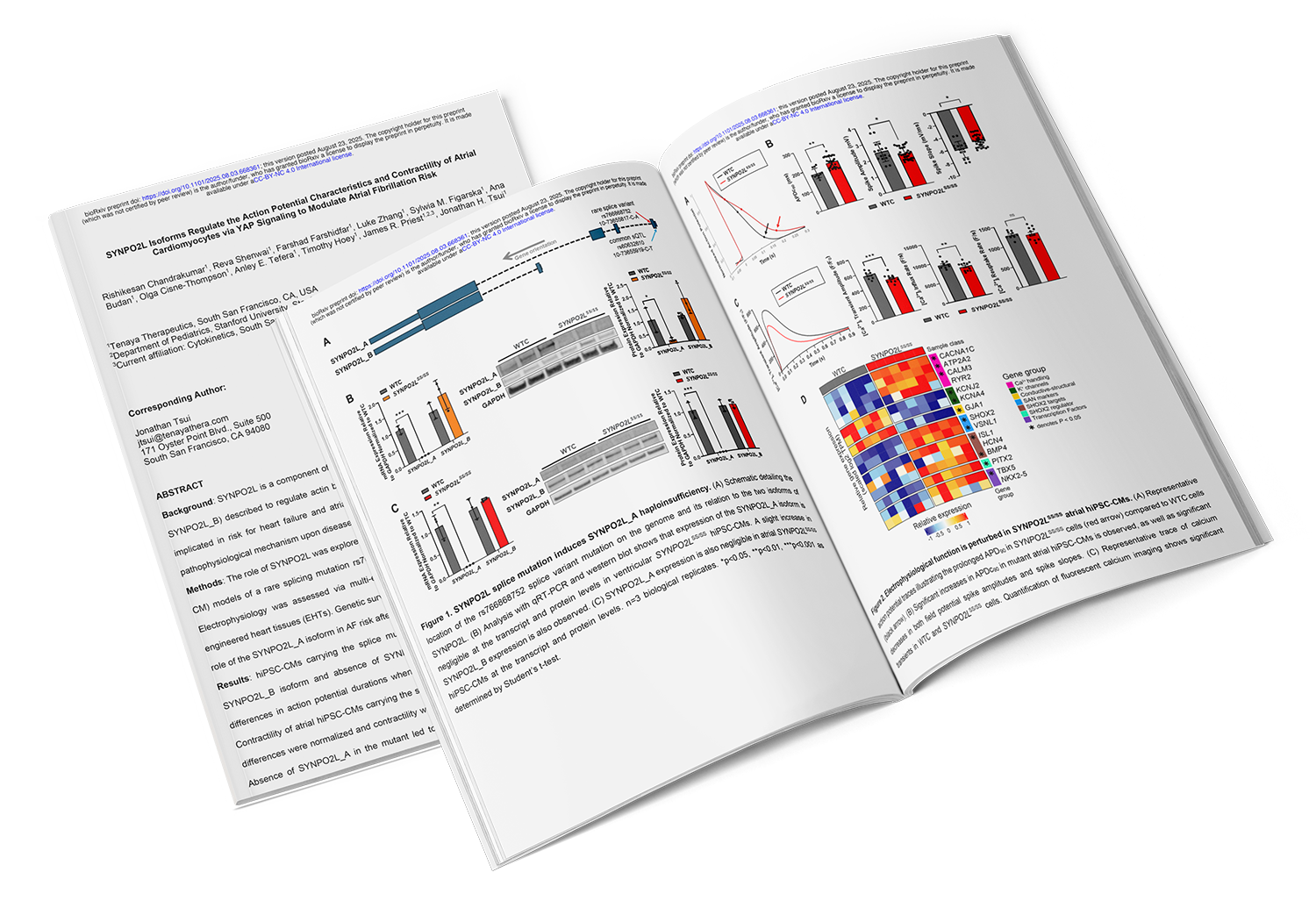
SYNPO2L Isoforms Regulate the Action Potential Characteristics and Contractility of Atrial Cardiomyocytes via YAP Signaling to Modulate Atrial Fibrillation Risk
Authors: Rishikesan Chandrakumar, Reva Shenwai, View ORCID ProfileFarshad Farshidfar, Luke Zhang, Sylwia M. Figarska, Ana Budan, Olga Cisne-Thompson, Anley E. Tefera, Timothy Hoey, View ORCID ProfileJames R. Priest, Jonathan H. Tsui
Originally Published in: bioRvix (August 2025)
Abstract
Background SYNPO2L is a component of the sarcomere Z-disk with two distinct isoforms (SYNPO2L_A and SYNPO2L_B) described to regulate actin bundle size. Common and rare variations in SYNPO2L have been implicated in risk for heart failure and atrial fibrillation (AF); however, little is known about the function or pathophysiological mechanism upon disease risk.
Methods The role of SYNPO2L was explored with human induced pluripotent stem cell cardiomyocyte (hiPSC-CM) models of a rare splicing mutation rs766868752 differentiated into both atrial and ventricular lineages. Electrophysiology was assessed via multi-electrode arrays (MEAs) and contractility was assessed using engineered heart tissues (EHTs). Genetic survival analyses were performed to explore the potential therapeutic role of the SYNPO2L_A isoform in AF risk after myocardial infarction.
Results hiPSC-CMs carrying the splice mutation rs766868752 resulted in preferential expression of the SYNPO2L_B isoform and absence of SYNPO2L_A isoform, and atrial hiPSC-CMs displayed significant differences in action potential durations when unpaced, and spontaneous extra-systolic beats when paced. Contractility of atrial hiPSC-CMs carrying the splice mutation was severely compromised. Electrophysiological differences were normalized and contractility was partially restored by overexpression with AAV:SYNPO2L_A. Absence of SYNPO2L_A in the mutant led to an observed decreased phosphorylation of YAP along with significant downstream transcriptional effects. A direct interaction between SYNPO2L_A and LATS2, a known regulator of YAP phosphorylation was found to occur in hiPSC-CMs. Additionally, a common variant time-to-event analysis may suggest a beneficial effect of the SYNPO2L_A isoform to lower the risk of atrial fibrillation after myocardial infarction.
Conclusions A rare splice mutation conferring isoform predominance of SYNPO2L_B appears to disturb the electrophysiology and contractility of atrial hiPSC-CMs via LATS2 phospho-regulatory effects upon YAP signaling. Supplementation of the SYNPO2L_A isoform can restore many functional deficits and supports a specific gene regulatory role for SYNPO2L in modulating the risk of AF and heart failure.
Competing Interest Statement
All authors were employees or contractors of Tenaya Therapeutics, Inc. at the time the work in this study was performed. All authors except for L.Z. and A.E.T. also hold equity in Tenaya Therapeutics, Inc.