
ROR2 drives right ventricular heart failure via disruption of proteostasis
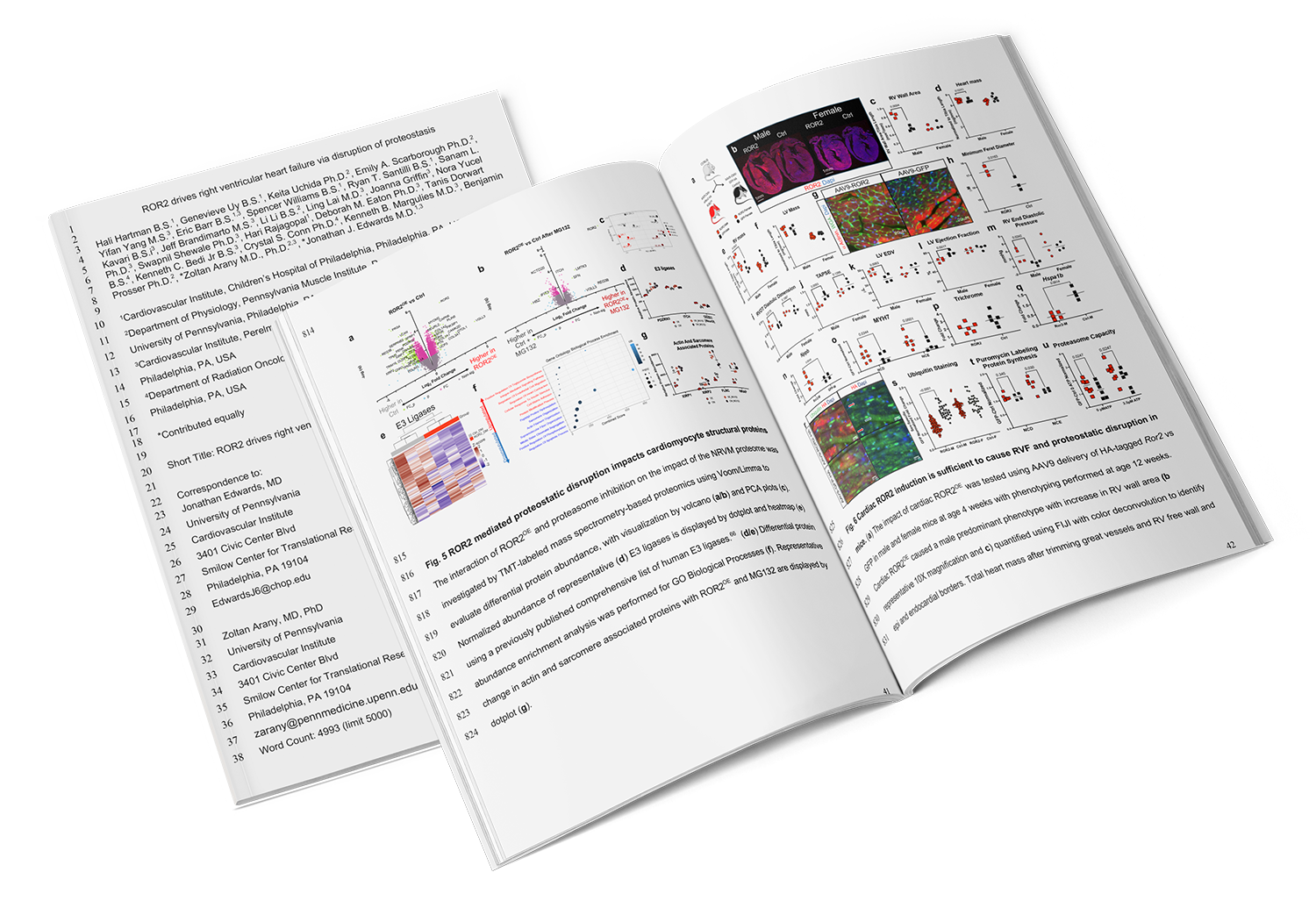
Authors: Hali Hartman, Genevieve Uy, Keita Uchida, Emily A. Scarborough, Yifan Yang, Eric Barr, Spencer Williams, Ryan T. Santilli, Sanam L. Kavari, Jeff Brandimarto, Li Li, Ling Lai, Joanna Griffin, Nora Yucel, Swapnil Shewale, Hari Rajagopal, Deborah M. Eaton, Tanis Dorwart, Kenneth C. Bedi Jr, Crystal S. Conn, Kenneth B. Margulies, Benjamin Prosser, Zoltan Arany, Jonathan J. Edwards
Originally Published in: bioRxiv (December 2025)
Abstract
Background No therapies exist to reverse right ventricular failure (RVF), and the molecular mechanisms that drive RVF remain under studied. We recently reported that the developmentally restricted noncanonical WNT receptor ROR2 is upregulated in human RVF in proportion to severity of disease. Here we test the mechanistic role of ROR2 in RVF pathogenesis.
Methods ROR2 was overexpressed or knocked down in neonatal rat ventricular myocytes (NRVMs) and then characterized using confocal microscopy, RNAseq, proteomics, proteostatic functional assays, and pacing to assess contractile properties. The impact of cardiac ROR2 expression was evaluated in mice by AAV9-mediated overexpression and by AAV9-mediated delivery of shRNA to knockdown ROR2 in a pulmonary artery banded pressure overload model of RVF. ROR2-modified mice were evaluated by echocardiography, histology, and RV protein synthesis and proteasome capacity.
Results In NRVMs, we find that ROR2 profoundly dysregulates the coordination between protein translation and folding. This imbalance leads to excess protein clearance by the ubiquitin proteasome system (UPS) with dramatic impacts on sarcomere and cytoskeletal structure and function. Inhibiting the UPS or restoring chaperone expression is sufficient to partially rescue ROR2-induced structural and contractile deficits in cardiomyocytes. In mice, forced cardiac ROR2 expression is sufficient to disrupt proteostasis and drive RVF, while conversely ROR2 knockdown partially rescues proteostasis and RV structure and function in a pressure overload model of RVF.
Conclusions In sum, ROR2 is a key driver of RVF pathogenesis through proteostatic disruption and, thus, provides a promising target to treat RVF.