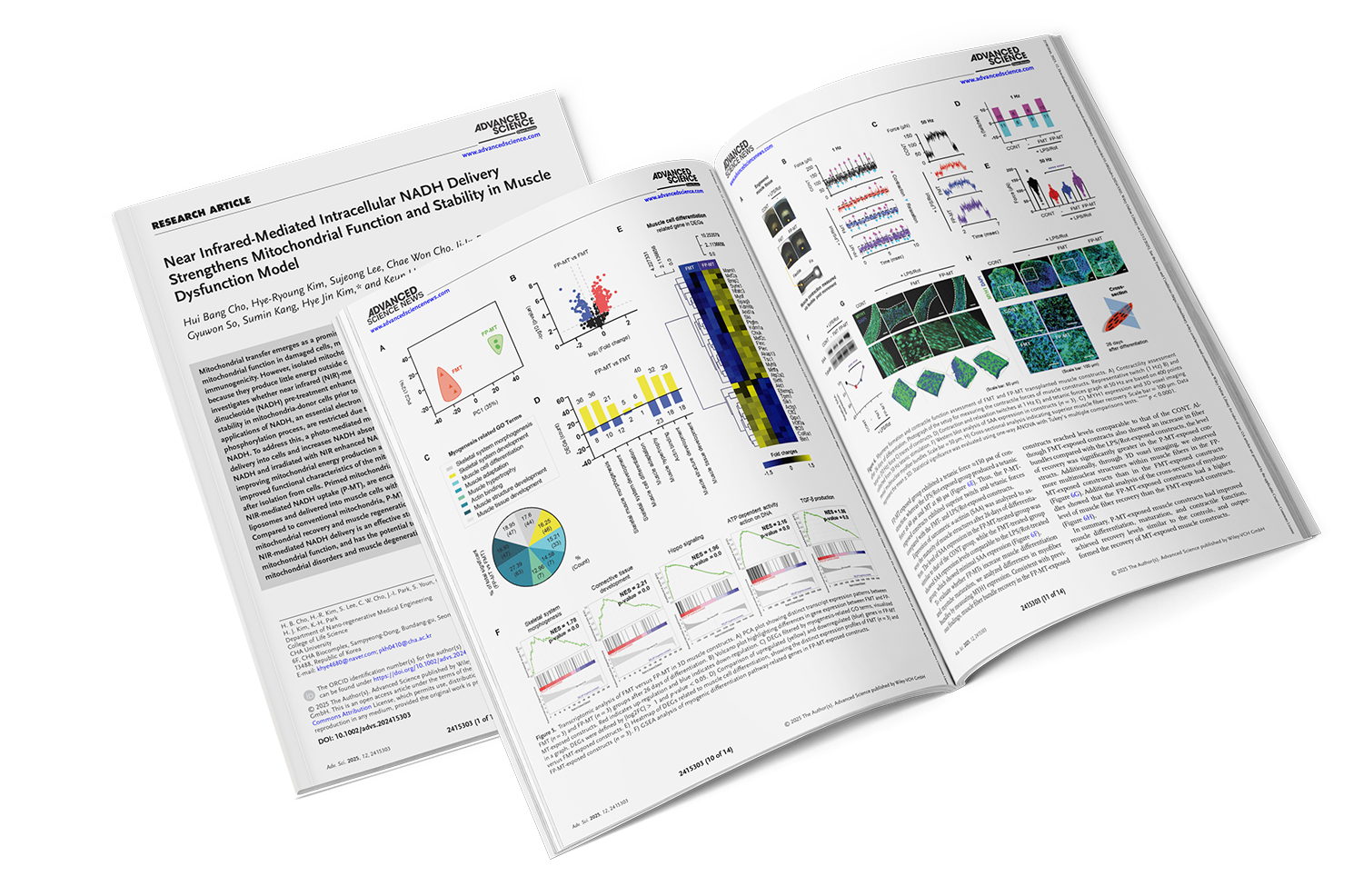
Near Infrared-Mediated Intracellular NADH Delivery Strengthens Mitochondrial Function and Stability in Muscle Dysfunction Model
Authors: Hui Bang Cho, Hye-Ryoung Kim, Sujeong Lee, Chae Won Cho, Ji-In Park, Seulki Youn, Gyuwon So, Sumin Kang, Hye Jin Kim, Keun-Hong Park
Originally Published in: Advanced Science (January 2025)
Abstract
Mitochondrial transfer emerges as a promising therapy for the restoration of mitochondrial function in damaged cells, mainly due to its limited immunogenicity. However, isolated mitochondria rapidly lose function because they produce little energy outside cells. Therefore, this study investigates whether near infrared (NIR)-mediated nicotinamide adenine dinucleotide (NADH) pre-treatment enhances mitochondrial function and stability in mitochondria-donor cells prior to transplantation. Clinical applications of NADH, an essential electron donor in the oxidative phosphorylation process, are restricted due to the limited cellular uptake of NADH. To address this, a photo-mediated method optimizes direct NADH delivery into cells and increases NADH absorption. L6 cells treated with NADH and irradiated with NIR enhanced NADH uptake, significantly improving mitochondrial energy production and function. Importantly, the improved functional characteristics of the mitochondria are maintained even after isolation from cells. Primed mitochondria, i.e., those enhanced by NIR-mediated NADH uptake (P-MT), are encapsulated in fusogenic liposomes and delivered into muscle cells with mitochondrial dysfunction. Compared to conventional mitochondria, P-MT mitochondria promote greater mitochondrial recovery and muscle regeneration. These findings suggest that NIR-mediated NADH delivery is an effective strategy for improving mitochondrial function, and has the potential to lead to novel treatments for mitochondrial disorders and muscle degeneration.