Where Human Science Meets Drug Discovery: Inside Curi Bio's 2026 Summer Workshop
The question preclinical researchers keep asking isn't whether human-relevant 3D tissue models work. It's how far they can go.
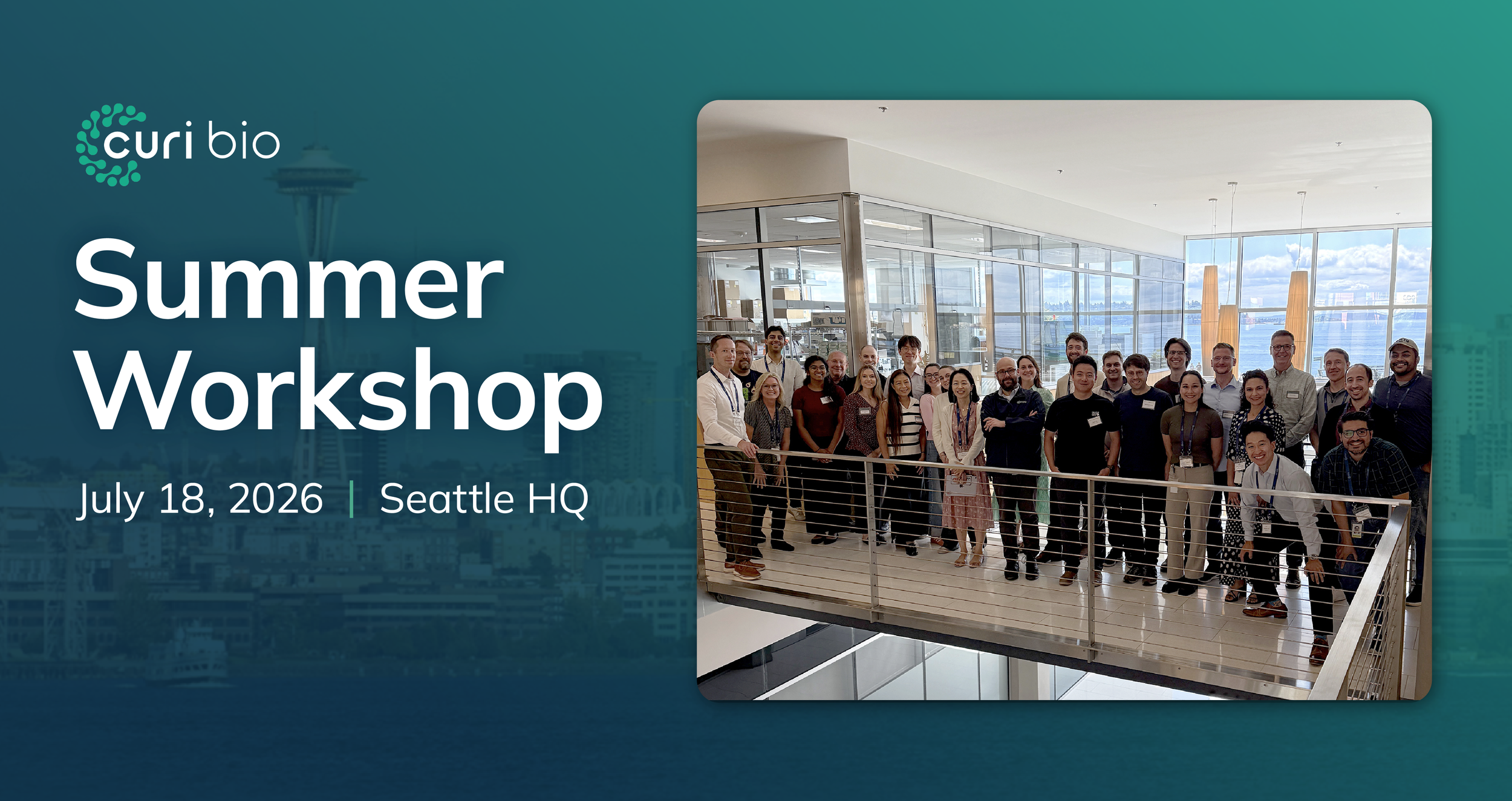
On July 18, 2026, Curi Bio brought that question to the forefront at our Seattle headquarters, hosting a full-day workshop that brought together scientists from some of the world's leading pharmaceutical companies, academic institutions, and Curi Bio's own research and engineering teams. The result was one of the most energized, scientifically rigorous, and exciting events we've hosted.
Here's what the day looked like, and why the conversations that happened here are shaping the future of drug discovery.
A Day Built Around Human Biology
The workshop opened at Curi Bio HQ with coffee, connection, and opening remarks from Nicholas Geisse, PhD, Curi Bio's co-founder and CEO, who framed the day around a singular ambition: to access functional human data that 2D and animal models simply cannot provide.
The scientific program that followed showcased the full range of what 3D engineered human muscle tissues are capable of, from skeletal and cardiac models to neuromuscular junction platforms, disease-specific phenotyping, and AI-enabled target validation.
Speakers Driving Real Change in Preclinical Discovery
David Mack, PhD, University of Washington opened the scientific sessions with "Using 3D Engineered Cardiac and Skeletal Muscle Tissues for Disease Modeling and Drug Discovery", grounding the day in the biology of why these models matter and the academic rigor behind their development.
Michael Stauske, PhD, AstraZeneca delivered one of the standout talks of the day with his "Industry Perspective on Implementing Advanced Human Models in Cardiovascular Drug Discovery." Dr. Stauske shared new and exciting high-quality cardiac safety screening data generated on Curi Bio's platform. His talk exemplified what is possible when global pharma brings human-relevant models into core cardiovascular research programs.
Monica Wang, PhD, UCB demonstrated how 3D human skeletal muscle platforms are expanding what researchers can model: "Modeling DM1-Associated Myotonia in a 3D Human Skeletal Muscle Platform." Her work on myotonic dystrophy type 1 highlights how disease-specific phenotypes that are difficult to replicate in traditional models are now accessible and reproducible in 3D.
Bee Pruzinsky, PhD, Cytokinetics presented "Characterization of Engineered Muscle Tissue (EMT) for Disease Modeling and Early-Stage Drug Discovery" showcasing how engineered muscle tissue is being integrated into upstream discovery workflows, enabling researchers to evaluate drug candidates at the earliest, most critical stages.
Timothy Petrie, PhD, Novo Nordisk took the audience through the data possibilities of scaled 3D tissue workflows in "Packing the Strength In: Insights from Higher Throughput 96 Tissue Plate Exploration." His findings on 96-well tissue plate protocols demonstrated the path toward the kind of throughput pharma requires for drug screening applications.
Elizabeth Kahle, PhD, Novo Nordisk delivered one of the most forward-looking talks of the day: "Toward an AI-Enabled Translational Skeletal Muscle Framework for Target Validation and Disease Modeling." Dr. Kahle outlined how AI and 3D tissue data are converging to create translational frameworks that bridge the gap between preclinical findings and clinical outcomes.
Jacob Fleming, Curi Bio rounded out the scientific program with "Engineering Neuromuscular Junction Models," presenting Curi Bio's work at the frontier of complex tissue engineering and the significant implications for neuromuscular disease research and botulinum neurotoxin potency testing.
From the Podium to the Lab
The afternoon moved from the conference room into Curi Bio's cutting-edge lab, where attendees experienced live, hands-on demonstrations of the Mantarray, Nautilai, and Nautilai Plus platforms. Curi Bio engineers and scientists were on the floor throughout, guiding participants through tissue casting, contractility assessment, and calcium analysis in real time.
The demos were not passive. Attendees asked deep technical questions, worked through protocol nuances directly with the team, and experienced the kind of data quality and reproducibility that makes 3D tissue technology a genuine alternative to legacy preclinical models. Many participants stayed well past the scheduled demo time, continuing conversations that carried naturally into the happy hour that followed.
The Energy in the Room
What stood out most, beyond the quality of the science, was the energy of the community.
Customers presented data and, in doing so, demonstrated the platform's capabilities more effectively than any product demonstration could. Attendees from different companies and institutions engaged with each other, comparing approaches and identifying opportunities for collaboration. Our engineers were present alongside commercial and science teams, making it possible for participants to get answers to questions that go beyond a standard demo.
What This Means for the Field
The Curi Bio Summer Workshop 2026 reinforced something we believe deeply: the shift toward human-relevant, new approach methodologies (NAMs) in preclinical research is not a distant aspiration. It is happening now, at scale, in the hands of researchers at the world's leading pharmaceutical and biotech organizations.
3D engineered muscle tissues, skeletal, cardiac, and neuromuscular, are generating functional human data that is informing drug discovery decisions, enabling disease modeling with precision that legacy systems cannot match, and accelerating the path toward safer, more effective medicines.
Join the Conversation
More Curi Bio Workshop World Tour locations and dates coming soon – stay tuned for the announcement of our next stop! If you're ready to explore how 3D human tissue technology can transform your preclinical research program, we'd love to connect.
Learn more about Curi Bio's platforms and capabilities at www.curibio.com.
Curi Bio is accelerating the discovery of the next generation of medicines by integrating human cells, systems, and data.