
HCM Disease Modeling: De-Risking Discovery with MYBPC3 Isogenic Pairs in 3D Engineered Heart Tissues (EHTs)
In the high-stakes world of drug discovery, especially for inherited diseases like Hypertrophic Cardiomyopathy (HCM), the greatest enemy of progress isn't just biological complexity; it’s noise.
Traditional preclinical models often leave researchers struggling to distinguish between a true therapeutic signal and the inherent biological noise of heterogeneous cell populations. When you are validating a life-changing gene therapy, "close enough" isn't enough. You need to know, with absolute certainty, that the changes you observe are a direct result of your intervention, not genetic background variability.
At Curi Bio, we believe the path to the clinic must be built on the "Human Standard." That is why we have developed a commercially available HCM isogenic pair that serves as the biological foundation for our holistic discovery ecosystem.
Solving the "Noise" Problem.
The secret to de-risking HCM programs starts with Isogenic MYBPC3 Cardiomyocytes. Mutations in the MYBPC3 gene are the leading cause of familial HCM, driving the hypercontractility, diastolic dysfunction, and progressive fibrotic remodeling that characterize the disease.
By utilizing a diseased cell line harboring a pathogenic exon 6 mutation (MYBPC3e6) alongside its genetically corrected isogenic control, researchers can finally perform a true "apples-to-apples" comparison. Because these cells share an identical genetic background, differing only at the precise mutation site, every delta measured in contractility, calcium sensitivity, or pharmacological response is a verified data point.
However, high-purity cells are only the beginning. To truly unlock their potential, they must be integrated into a functional environment.
Validation: Recapitulating the Human Condition in 3D
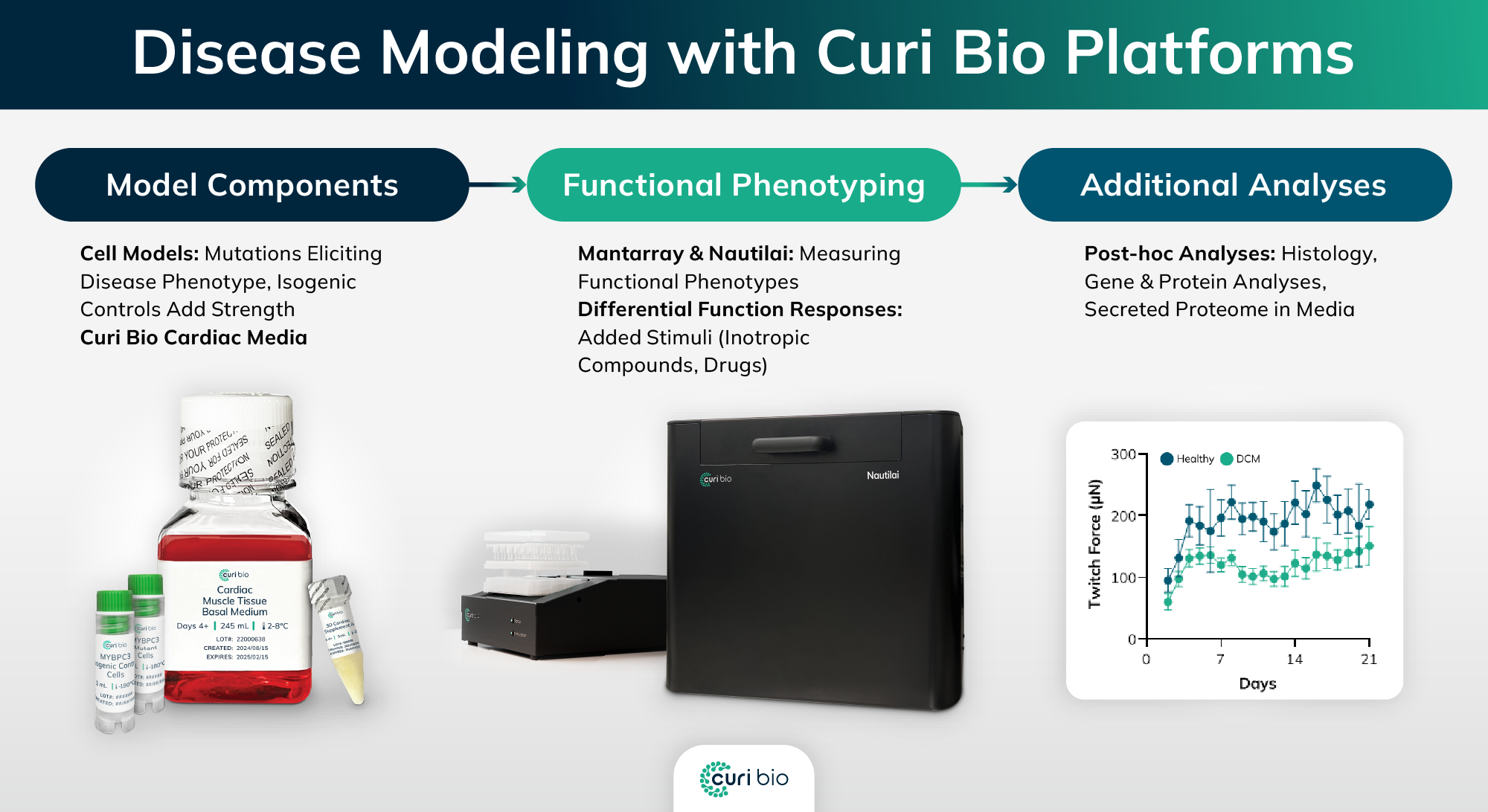
Our latest application note demonstrates the power of the Curi Bio Ecosystem, by integrating Cells (MYBPC3e6), Biosystems (Mantarray™), and Data Analytics (Pulse™) to recapitulate human clinical phenotypes:
Hypercontractility & Fibrosis: When cast into 3D EHTs on the Mantarray platform, MYBPC3e6 cells consistently exhibit elevated twitch force compared to isogenic controls. These models even develop fibrotic lesions, with hypercellular nodules positive for ɑ-SMA and TGF-β1, mirroring the remodeling seen in HCM patients.
Calcium Hypersensitivity: Our isogenic EHTs demonstrate a markedly heightened inotropic response to increasing calcium concentrations. This enhanced myofilament calcium sensitivity is a hallmark of the disease that can be accurately captured and quantified in our functional 3D environment.
Chronotropic Dysfunction: Much like a clinical stress test, the Mantarray system allows for progressively increased pacing frequencies. Under this stress, MYBPC3e6 EHTs show impaired pacing fidelity and reduced survival, mirroring the diminished chronotropic reserve observed in clinical settings.
From Bench to Bedside with Ecosystem Clarity
The ultimate goal of any preclinical platform is to predict human response. By combining our high-purity iPSC-derived cardiomyocytes and specialized cardiac media with the Mantarray’s precision hardware and Pulse’s automated analytics, we provide a unified ecosystem designed for stability and maturation.
This ecosystem has already proven its utility in pharmacological screening. For example, the myosin inhibitor mavacamten, a clinical standard for HCM, successfully rescued elevated spontaneous twitch frequencies and slowed relaxation kinetics in our 3D EHT model.
Eliminate the Variables.
Stop letting genetic noise hide your next breakthrough. By moving to a validated, isogenic human standard supported by a complete discovery ecosystem, you can de-risk your program, strengthen your regulatory submissions, and get effective therapies to patients sooner.
Ready to see the full data?
Download our technical application note, "Modeling Hypertrophic Cardiomyopathy in 3D: Functional Characterization of Curi Bio's MYBPC3e6 Isogenic Pair," to explore how our integrated ecosystem can accelerate your cardiac research.