
Eliminating 3D Tissue Detachment: Why Optimized Media is the Key to Functional Skeletal Muscle Models
Have you ever spent weeks carefully differentiating human induced pluripotent stem cells (hiPSCs), casting them into 3D constructs, and eagerly waiting for that first muscle contraction, only to find your tissues either ignoring the stimulus completely or tearing themselves off the posts?
We’ve all been there. It is incredibly frustrating to watch a month of hard work unravel because a tissue simply failed to mature or could not handle the physical tension of its own environment.
When researchers run into this wall, the instinct is usually to blame the cells. But what if the cells are perfectly fine? Think of it this way: your iPSC-derived cells are the "seeds." You can start with the highest-quality, most precisely edited seeds available, like Curi Bio’s iPSC-Skeletal Muscle Cells, which are specifically optimized for 3D applications. But if you plant them in poor "soil," they simply will not grow into a strong, deeply rooted tissue. In 3D tissue engineering, your culture media is that soil.
The Heavy Lifting of 3D Biology
Traditional 2D media formulations were never designed to support the intense metabolic, mechanical and structural demands of a 3D environment. In a 3D construct, cells are not just resting flat on a piece of plastic. They are suspended in a hydrogel, constantly exerting significant tensile forces against anchor points, generating static tension, essential for myotube alignment. Furthermore, they must actively communicate with neighboring support cells, such as fibroblasts, to remodel their initial hydrogel environment into a functional, collagen-rich extracellular matrix (ECM).
If you use standard media, you often run into a frustrating balancing act. The media might encourage too much cell division, overcrowding the matrix. This leads to aggressive remodeling and overcompaction of the tissue, undermining its long-term structural integrity. Alternatively, the media might fail to provide the precise metabolic cues needed for myoblasts to fuse properly. The result? Weak, immature tissues that snap and detach the moment you apply an electrical stimulus or try to measure their contractile force.
Providing the Perfect "Soil"
To get human-relevant, highly predictive data for drug discovery, you need tissues that actually behave like human muscle. This is exactly why we formulated Curi Bio’s Skeletal Muscle Tissue Medium.
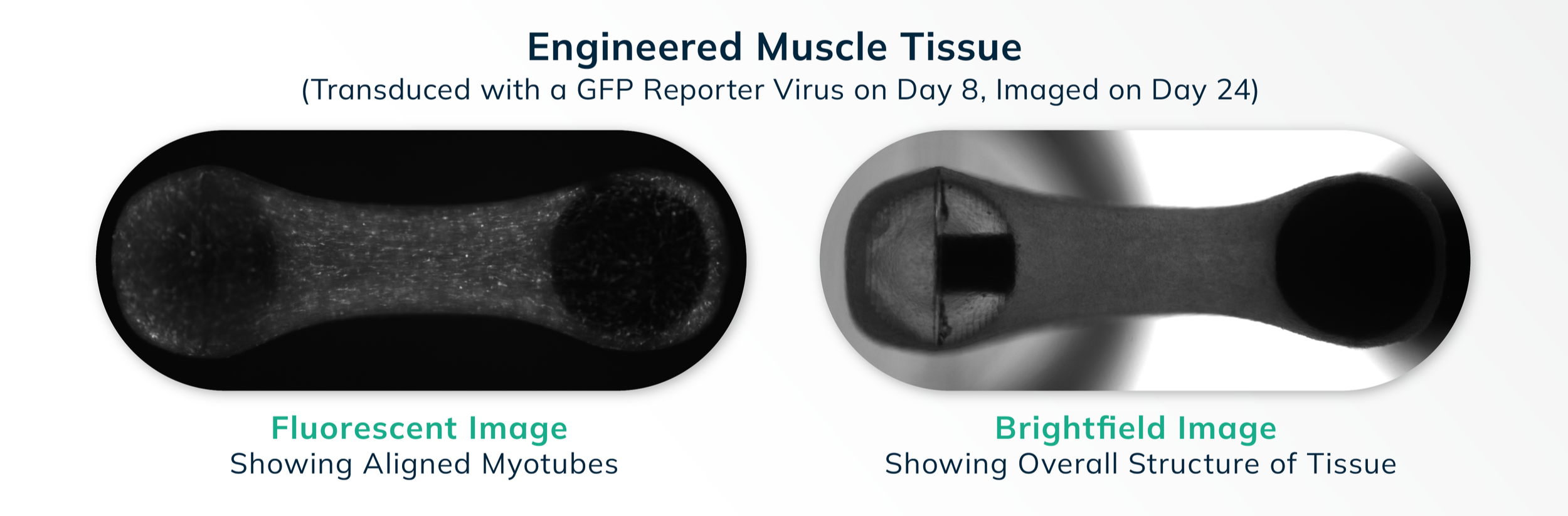
Our serum-free formula is specifically designed to act as the perfect soil for your 3D models. It deliberately limits rampant cell proliferation within the matrix, directing the myoblasts to focus entirely on differentiation. The medium promotes the robust fusion of these myoblasts into mature, multinucleated myotubes that align properly within the 3D hydrogel. Beyond initial maturation, the formulation provides the precise metabolic cues necessary for the tissue to establish a stable homeostasis, ensuring the long-term viability and functional consistency required for chronic dosing studies.
Built to Withstand the Stress
Stronger tissues aren’t just a biological win; they are a data win. When you are screening a new therapeutic for a neuromuscular disease, you need your engineered muscle tissues (EMTs) to be robust enough to undergo rigorous, repeated contractility assays without falling apart.
Because our media supports stable matrix development and maintains the long-term health of our human muscle cells, the resulting syncytium is physically strong. When these tissues are robust enough to withstand the mechanical loading of a platform like the Mantarray, you unlock a level of functional quantification, measuring millinewton-level twitch and tetanic forces that 2D models simply cannot touch.
By giving your "seeds" the right "soil," you eliminate the constant headache of tissue detachment and delayed maturation. You get reliable, long-lasting tissues that deliver the physiological data you need to make confident decisions in your drug development pipeline.
Stop losing weeks of R&D to tissue failure. Don't let your biology limit your discovery. Bundle your cells and media for guaranteed 3D maturation and stronger data.